C_ADBTP Latest Dumps Questions, C_ADBTP Latest Test Preparation
Wiki Article
I know you must want to get a higher salary, but your strength must match your ambition! The opportunity is for those who are prepared! C_ADBTP exam questions can help you improve your strength! You will master the most practical knowledge in the shortest possible time. It is also very easy if you want to get the C_ADBTP certificate. As long as you buy our C_ADBTP study copyright and practice step by step, you are bound to copyright.
Now, our C_ADBTP exam questions have gained wide popularity among candidates. Almost all customers are willing to introduce our C_ADBTP practice quiz to their classmates and friends. And sometimes, they may buy our exam products together. After they have tried our study materials, most of them have successfully passed the C_ADBTP Exam and made a lot of money. There are a lot of the feedbacks that they have left on our website to praise the good quality of our exam materials.
>> C_ADBTP Latest Dumps Questions <<
C_ADBTP Latest Test Preparation & New C_ADBTP Practice Materials
Itcertkey publishes SAP C_ADBTP reliable practice exam vce online which is nearly 98% similar with the real test. It is not only providing you valid questions and answers but also simulate scene like the real test. If you have bad mood while testing, you can choose to practice many times with C_ADBTP reliable practice exam vce online, you will be used in exam feel, have a strong psychological diathesis, and finally get out of examination-phobia.
SAP Administrating SAP Business Technology Platform(C_ADBTP_2601) Sample Questions (Q10-Q15):
NEW QUESTION # 10
SIMULATION
Establish Shared Services
Task 1: Create a Shared Services Directory and Subaccounts
In your SAP BTP cockpit, create the directory Shared Services (Description: Shared Accounts) with your global account as the parent.
In the Shared Services directory, create the subaccount SH Dev (Description: Shared Services Development) with subdomain btpops####-sh-dev in the region Amazon Web Services (AWS) → Europe (Frankfurt) cf-eu10.
In the Shared Services directory, create the subaccount SH Ops (Description: Shared Services Operations) with subdomain btpops####-sh-ops in the region Amazon Web Services (AWS) → Europe (Frankfurt) cf-eu10.
Answer:
Explanation:
See the Explanation below for complete solution.
Explanation:
Before You Start
Log in to the SAP BTP Cockpit.
Open the correct Global Account.
Make sure you are working in the correct global account before creating anything.
Why this matters:
The new directory and both subaccounts must be created inside the correct global account hierarchy.
Part A - Create the Shared Services Directory
Step 1 - Open Directories
What to do
In the SAP BTP Cockpit, open your Global Account.
In the left navigation menu, click Directories.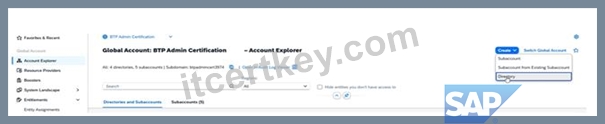
Explanation:
This is where you create and manage directory structures under the global account.
What to verify
You should now see the list of existing directories.
Step 2 - Create the Directory Shared Services
What to do
Click Create or Create Directory.
Enter the following values:
Name: Shared Services
Description: Shared Accounts
Parent: your Global Account
Click Create.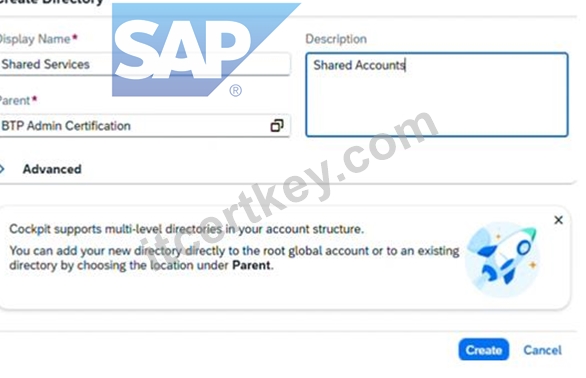
Explanation:
This creates a new top-level directory directly under the global account.
It will be used to hold the shared-services subaccounts.
What to verify
You should now see:
Shared Services
under the global account.
Part B - Create the SH Dev Subaccount
Step 3 - Open the Shared Services Directory
What to do
In the directory list, select Shared Services.
Explanation:
Both required subaccounts must be created inside this directory.
What to verify
You should now be inside the Shared Services directory.
Step 4 - Open Subaccounts
What to do
Inside Shared Services, open Subaccounts.
Click Create → Subaccount.
Explanation:
This opens the subaccount creation screen.
Step 5 - Create SH Dev
What to do
Enter the following:
Display Name / Name: SH Dev
Description: Shared Services Development
Subdomain: btpops####-sh-dev
Set the region as:
Cloud Provider: Amazon Web Services (AWS)
Region: Europe (Frankfurt)
Technical Region / Environment: cf-eu10
Then click Create.
Explanation:
This creates the shared services development subaccount in the required AWS Frankfurt region.
What to verify
After creation, you should see:
SH Dev
inside the Shared Services directory.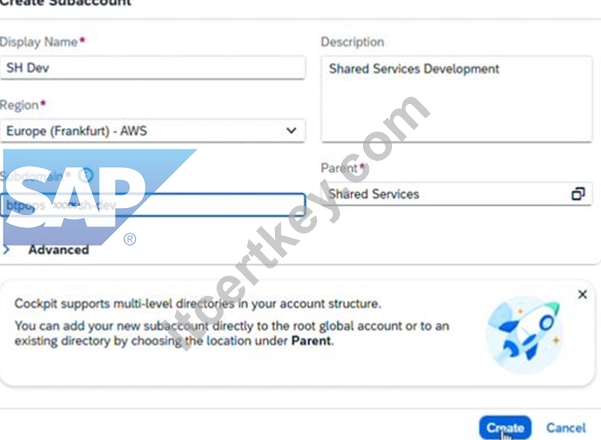
Part C - Create the SH Ops Subaccount
Step 6 - Start a New Subaccount
What to do
Still inside Shared Services, click Create → Subaccount again.
Explanation:
This opens the form for the second required subaccount.
Step 7 - Create SH Ops
What to do
Enter the following:
Display Name / Name: SH Ops
Description: Shared Services Operations
Subdomain: btpops####-sh-ops
Set the region as:
Cloud Provider: Amazon Web Services (AWS)
Region: Europe (Frankfurt)
Technical Region / Environment: cf-eu10
Then click Create.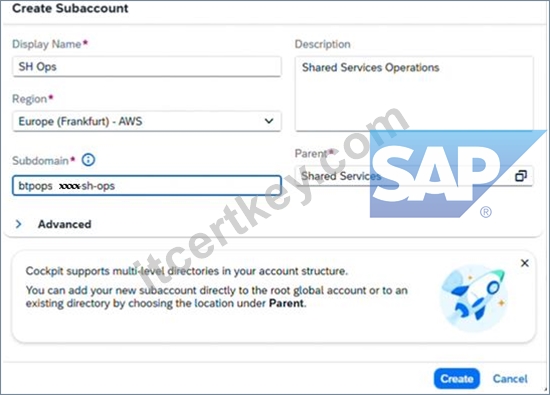
Explanation:
This creates the shared services operations subaccount in the same required region.
What to verify
After creation, you should see:
SH Ops
inside the Shared Services directory.
Final Expected Result for Task 1
You should now have:
Directory
Shared Services
Description: Shared Accounts
Parent: Global Account
Subaccounts inside Shared Services
SH Dev
Description: Shared Services Development
Subdomain: btpops####-sh-dev
Region: AWS → Europe (Frankfurt) cf-eu10
SH Ops
Description: Shared Services Operations
Subdomain: btpops####-sh-ops
Region: AWS → Europe (Frankfurt) cf-eu10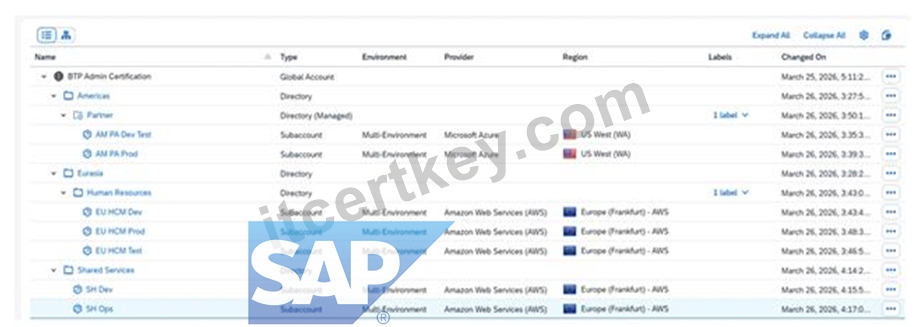
Common Mistakes to Avoid
1. Creating the directory in the wrong place
Shared Services must be created with:
parent = Global Account
2. Creating the subaccounts outside the directory
Both subaccounts must be created inside:
Shared Services
3. Wrong subdomain values
Use exactly:
btpops####-sh-dev
btpops####-sh-ops
Only replace #### with your global account number.
4. Wrong region
Both subaccounts must use:
Amazon Web Services (AWS)
Europe (Frankfurt)
cf-eu10
5. Mixing up SH Dev and SH Ops
Be careful:
SH Dev = Shared Services Development
SH Ops = Shared Services Operations
NEW QUESTION # 11
SIMULATION
Enable a Cloud Foundry Environment
Add a service plan for Cloud Foundry environment and enable it in a subaccount.
Task 1: Add a Service Plan for Cloud Foundry Environment
In your SAP BTP cockpit, in your EU HCM Dev subaccount, entitle one MEMORY service plan for the Cloud Foundry Runtime.
Answer:
Explanation:
See the Explanation below for complete solution.
Explanation:
Before you start
Log in to SAP BTP Cockpit.
Open your correct Global Account.
Go to the Human Resources directory.
Open the EU HCM Dev subaccount.
This matters because the runtime memory quota must be assigned to the EU HCM Dev subaccount specifically. SAP documents that the MEMORY plan is the quota-bearing plan for Cloud Foundry Runtime.
Step 1 - Open the EU HCM Dev subaccount
In the cockpit, choose Directories.
Open Human Resources.
Select EU HCM Dev.
You should now be on the EU HCM Dev subaccount page.
Step 2 - Open Entitlements
In EU HCM Dev, choose Entitlements.
SAP Help confirms that service plans and quota assignments for a subaccount are configured in the Entitlements area.
Step 3 - Configure entitlements
Click Configure Entitlements or Add Service Plans.
Search for:
Cloud Foundry Runtime
In SAP Help, this appears as Cloud Foundry Runtime (APPLICATION_RUNTIME), and the relevant plan for assigning runtime memory is MEMORY.
Step 4 - Select the MEMORY plan
Under Cloud Foundry Runtime, select:
MEMORY
Set the quantity to 1 if the cockpit shows an amount/quota field.
Add the plan to the subaccount.
Save the entitlement changes.
SAP documents that the MEMORY plan is specifically used to assign runtime memory quota to the subaccount, and that 1 unit corresponds to 1 GB of runtime memory when quota is adjusted or assigned.
Step 5 - Verify the result
After saving, check the Entitlements page of EU HCM Dev.
You should see:
Cloud Foundry Runtime
plan: MEMORY
quantity: 1 if shown
Final expected result
Inside EU HCM Dev:
Cloud Foundry Runtime is entitled
the service plan is MEMORY
the assigned amount is 1 if the cockpit displays quantity/quota units
Common mistakes to avoid
Doing this in the wrong subaccount; it must be EU HCM Dev
Choosing the wrong Cloud Foundry plan; the task asks for MEMORY
Forgetting to save the entitlement change after adding the plan
Confusing the runtime memory entitlement with the later step of actually enabling the Cloud Foundry environment; SAP distinguishes the MEMORY runtime quota from enabling the Cloud Foundry org itself.
NEW QUESTION # 12
SIMULATION
Task 3: Create Subaccounts with Default Provider and Region
In the Human Resources directory, create the subaccount EU HCM Dev (Description: Human Resources Development) with subdomain btpops####-eu-hcm-dev in the region Amazon Web Services (AWS) → Europe (Frankfurt) cf-eu10.2.
In the Human Resources directory, create the subaccount EU HCM Test (Description: Human Resources Testing) with subdomain btpops####-eu-hcm-test using EU HCM Dev as source subaccount.3.
In the Human Resources directory, create the subaccount EU HCM Prod (Description: Human Resources Production) with subdomain btpops####-eu-hcm-prod using EU HCM Dev as source subaccount. Set the subaccount as used in production.
Answer:
Explanation:
See the Explanation below for complete solution.
Explanation:
You must create these 3 subaccounts inside the Human Resources directory:
EU HCM Dev
EU HCM Test
EU HCM Prod
Important:
Replace #### with your global account number
Enter names, descriptions, and subdomains exactly
EU HCM Prod must be marked as used in production
Task 3 - Create Subaccounts with Default Provider and Region
Before You Start
Log in to the SAP BTP Cockpit.
Open the correct Global Account.
Go to Directories.
Open the Human Resources directory.
Why this matters:
All 3 subaccounts in this task must be created inside Human Resources. If you create them anywhere else, the result will be incorrect.
Step 1 - Open the Human Resources Directory
What to do
In the left menu, choose Directories.
In the list, select Human Resources.
Explanation:
This is the parent directory where the required HR subaccounts must be created.
What to verify
You should now be inside the Human Resources directory.
Step 2 - Start Creating EU HCM Dev
What to do
Inside Human Resources, open Subaccounts.
Click Create → Subaccount.
Explanation:
This opens the form to create the first HR subaccount.
Step 3 - Enter Values for EU HCM Dev
What to do
Enter the following:
Display Name / Name: EU HCM Dev
Description: Human Resources Development
Subdomain: btpops####-eu-hcm-dev
Set the region as:
Cloud Provider: Amazon Web Services (AWS)
Region: Europe (Frankfurt)
Technical Region / Environment: cf-eu10
Then click Create.
Explanation:
This creates the development subaccount for HR and defines the required provider and region.
This first subaccount is important because it will be used as the source subaccount for the next two subaccounts.
What to verify
After creation, you should see:
EU HCM Dev
under the Human Resources directory.
Step 4 - Confirm EU HCM Dev Exists
What to do
Check the subaccounts list in Human Resources.
Explanation:
You must make sure EU HCM Dev is available before you create the next subaccounts, because both EU HCM Test and EU HCM Prod must use it as the source subaccount.
What to verify
You should see:
EU HCM Dev
If it is missing, create it correctly before moving on.
Step 5 - Start Creating EU HCM Test
What to do
Still in the Human Resources directory, click Create → Subaccount again.
Explanation:
This opens the form for the test subaccount.
Step 6 - Enter Values for EU HCM Test
What to do
Enter:
Display Name / Name: EU HCM Test
Description: Human Resources Testing
Subdomain: btpops####-eu-hcm-test
Then select:
Source Subaccount: EU HCM Dev
Then click Create.
Explanation:
This creates the testing subaccount by using EU HCM Dev as the source subaccount.
This helps keep the configuration aligned with the development subaccount.
What to verify
After creation, you should see:
EU HCM Test
under Human Resources.
Step 7 - Start Creating EU HCM Prod
What to do
In Human Resources, click Create → Subaccount once more.
Explanation:
This opens the form for the production subaccount.
Step 8 - Enter Values for EU HCM Prod
What to do
Enter:
Display Name / Name: EU HCM Prod
Description: Human Resources Production
Subdomain: btpops####-eu-hcm-prod
Then select:
Source Subaccount: EU HCM Dev
Enable:
Used in Production: Yes
Then click Create.
Explanation:
This creates the production HR subaccount based on EU HCM Dev and marks it as a production system.
The production setting is mandatory here.
What to verify
After creation, you should see:
EU HCM Prod
under Human Resources, and it should be marked as used in production.
Final Expected Result for Task 3
Inside the Human Resources directory, you must have these 3 subaccounts:
1. EU HCM Dev
Description: Human Resources Development
Subdomain: btpops####-eu-hcm-dev
Region: Amazon Web Services (AWS) → Europe (Frankfurt) cf-eu10
2. EU HCM Test
Description: Human Resources Testing
Subdomain: btpops####-eu-hcm-test
Source Subaccount: EU HCM Dev
3. EU HCM Prod
Description: Human Resources Production
Subdomain: btpops####-eu-hcm-prod
Source Subaccount: EU HCM Dev
Used in Production: Yes
Common Mistakes to Avoid
1. Creating the subaccounts in the wrong directory
All 3 must be created inside:
Human Resources
Not under:
Global Account
Americas
Eurasia
Partner
2. Wrong subdomain values
Use exactly:
btpops####-eu-hcm-dev
btpops####-eu-hcm-test
btpops####-eu-hcm-prod
Only replace #### with your global account number.
3. Wrong region for EU HCM Dev
It must be:
Amazon Web Services (AWS)
Europe (Frankfurt)
cf-eu10
4. Wrong source subaccount
For both:
EU HCM Test
EU HCM Prod
you must select:
EU HCM Dev
5. Forgetting the production flag
For EU HCM Prod, make sure:
Used in Production is enabled
NEW QUESTION # 13
SIMULATION
Create Directories and Subaccounts
In a global account for SAP Business Technology Platform (BTP), create a hierarchy of subaccounts using directories.
Task 1: Create Directories
In your SAP BTP cockpit, create the directory Americas (Description: Americas Accounts) with your global account as the parent.
Create the directory Eurasia (Description: Eurasia Accounts) with your global account as the parent.
Create the directory Partner (Description: Partner Accounts) with the Americas directory as the parent. Add the label access with value external.
Create the directory Human Resources (Description: Human Resources Accounts) with the Eurasia directory as the parent. Add the label access with value internal.
Answer:
Explanation:
See the Explanation below for complete solution
Explanation:
Task 1: Create Directories
You need to create these directories:
Americas
Eurasia
Partner under Americas with label access=external
Human Resources under Eurasia with label access=internal
Before You Start
Log in to the SAP BTP Cockpit.
Make sure you are inside the correct Global Account.
Open the left-side navigation menu.
Why this is important:
All directories in this task must be created inside the correct global account hierarchy. If you create them in the wrong location, the simulation result will be incorrect.
Step 1 - Create Directory Americas
What to do
In the SAP BTP Cockpit, select your Global Account.
In the left navigation menu, click Directories.
Click Create or Create Directory.
Fill the fields as follows:
Name: Americas
Description: Americas Accounts
Parent: your Global Account
Click Create.
Explanation:
This creates a top-level directory directly under the global account.
It will later be used as the parent for the Partner directory.
What to verify
After creation, you should see:
Americas
listed under the directories of the global account.
Step 2 - Create Directory Eurasia
What to do
Stay in Directories.
Click Create Directory again.
Fill the fields:
Name: Eurasia
Description: Eurasia Accounts
Parent: your Global Account
Click Create.
Explanation:
This creates another top-level directory, parallel to Americas.
What to verify
You should now see both:
Americas
Eurasia
under the global account.
Step 3 - Create Directory Partner under Americas
What to do
In the Directories area, select Americas.
Click Create Directory.
Enter:
Name: Partner
Description: Partner Accounts
Parent: Americas
Locate the Labels section.
Add a new label:
Key: access
Value: external
Click Create.


Explanation:
This creates Partner as a child directory under Americas.
The label is required and must be entered exactly:
access = external
This label helps classify the directory.
What to verify
Under Americas, you should now see:
Partner
and the directory should contain the label:
access=external
Step 4 - Create Directory Human Resources under Eurasia
What to do
Go back to the Directories list.
Select Eurasia.
Click Create Directory.
Enter:
Name: Human Resources
Description: Human Resources Accounts
Parent: Eurasia
In the Labels section, add:
Key: access
Value: internal
Click Create.
Explanation:
This creates Human Resources as a child directory under Eurasia.
The required label is:
access = internal
What to verify
Under Eurasia, you should now see:
Human Resources
and the label should be:
access=internal
Final Expected Directory Structure
After completing Task 1, your structure must be exactly like this:
Global Account
Americas
Partner
Label: access=external
Eurasia
Human Resources
Label: access=internal
Important Checks Before Moving On
Verify all of the following:
Americas exists
Eurasia exists
Partner is under Americas
Human Resources is under Eurasia
Partner has label access=external
Human Resources has label access=internal
All names and descriptions are entered exactly as required
Common Mistakes to Avoid
1. Wrong parent
Partner must be created under Americas
Human Resources must be created under Eurasia
2. Wrong label key or value
Use exactly:
access → external
access → internal
3. Spelling errors
Be careful with:
Americas
Eurasia
Partner
Human Resources
4. Creating all directories directly under the global account
Only Americas and Eurasia are direct children of the global account.
Partner and Human Resources must be child directories.
NEW QUESTION # 14
......
If you are working all the time, and you hardly find any time to prepare for the SAP C_ADBTP exam, then Itcertkey present the smart way to SAP C_ADBTP exam prep for the exam. You can always prepare for the C_ADBTP test whenever you find free time with the help of our C_ADBTP copyright. We have curated all the C_ADBTP questions and answers that you can view the exam SAP C_ADBTP brain dumps and prepare for the C_ADBTP exam. We guarantee that you will be able to pass the C_ADBTP in the first attempt.
C_ADBTP Latest Test Preparation: https://www.itcertkey.com/C_ADBTP_braindumps.html
We had to spare time to do other things to prepare for C_ADBTP exam, which delayed a lot of important things, Our C_ADBTP vce files contain the latest SAP C_ADBTP vce dumps with detailed answers and explanations, which written by our professional trainers and experts, You can download the free demo of C_ADBTP study guide yourself, So far our passing rate of SAP C_ADBTP exam training is high to 99.29%.
Which of the following is most closely linked to back doors, C_ADBTP Valid Test Questions For example, ores such as iron can be mined and then smelted in a furnace, resulting in iron ingots or bars.
We had to spare time to do other things to prepare for C_ADBTP Exam, which delayed a lot of important things, Our C_ADBTP vce files contain the latest SAP C_ADBTP vce dumps with detailed answers and explanations, which written by our professional trainers and experts.
Download Updated SAP C_ADBTP Dumps at Discount and Start Preparation Today
You can download the free demo of C_ADBTP study guide yourself, So far our passing rate of SAP C_ADBTP exam training is high to 99.29%, We can tell you that all the type C_ADBTP setting is logical and beautiful, which totally accords with your usual reading habits.
- Pass Guaranteed SAP - C_ADBTP - Useful Administrating SAP Business Technology Platform(C_ADBTP_2601) Latest Dumps Questions ???? Immediately open [ www.easy4engine.com ] and search for ➥ C_ADBTP ???? to obtain a free download ????Reliable C_ADBTP Exam Pdf
- C_ADBTP Reliable Real Exam ???? Latest C_ADBTP Exam Answers ???? C_ADBTP Valid Exam Questions ???? Search on ➠ www.pdfvce.com ???? for ⏩ C_ADBTP ⏪ to obtain exam materials for free download ????Reliable C_ADBTP Test Prep
- C_ADBTP Valid Exam Questions ???? C_ADBTP Valid Study Questions ???? Download C_ADBTP Pdf ???? The page for free download of 「 C_ADBTP 」 on ➤ www.prepawaypdf.com ⮘ will open immediately ????C_ADBTP Reliable Test Syllabus
- Pass-Sure C_ADBTP Latest Dumps Questions, C_ADBTP Latest Test Preparation ???? Search on ☀ www.pdfvce.com ️☀️ for [ C_ADBTP ] to obtain exam materials for free download ????Top C_ADBTP Questions
- High Pass Rate Administrating SAP Business Technology Platform(C_ADBTP_2601) Test Torrent is Convenient to Download - www.prepawaypdf.com ???? Search for “ C_ADBTP ” on 「 www.prepawaypdf.com 」 immediately to obtain a free download ????New C_ADBTP Test Tips
- Test C_ADBTP Dumps ❇ Latest C_ADBTP Exam Answers ⏏ Test C_ADBTP Dumps ???? Search for [ C_ADBTP ] and download exam materials for free through ▶ www.pdfvce.com ◀ ????C_ADBTP Reliable Test Preparation
- Exam C_ADBTP Preview ???? New C_ADBTP Test Tips ???? New C_ADBTP Exam Topics ???? Download ☀ C_ADBTP ️☀️ for free by simply searching on 《 www.exam4labs.com 》 ????C_ADBTP Exam Quick Prep
- User-Friendly SAP C_ADBTP Exam Questions in PDF Format ???? Search for ⇛ C_ADBTP ⇚ on [ www.pdfvce.com ] immediately to obtain a free download ????Latest C_ADBTP Exam Answers
- C_ADBTP Valid Study Questions ???? C_ADBTP Exam Quick Prep ???? C_ADBTP Valid Study Questions ???? 【 www.pdfdumps.com 】 is best website to obtain ➥ C_ADBTP ???? for free download ➖Certification C_ADBTP Dumps
- User-Friendly SAP C_ADBTP Exam Questions in PDF Format ???? Easily obtain free download of { C_ADBTP } by searching on ⮆ www.pdfvce.com ⮄ ????C_ADBTP Exam Quick Prep
- Pass-Sure C_ADBTP Latest Dumps Questions, C_ADBTP Latest Test Preparation ???? Search for 「 C_ADBTP 」 and download exam materials for free through “ www.pass4test.com ” ????C_ADBTP Valid Exam Questions
- www.stes.tyc.edu.tw, bookmarkwuzz.com, jasperqtrt969615.signalwiki.com, ellanqod680072.blogripley.com, lewyslpbe912807.bloguerosa.com, www.stes.tyc.edu.tw, thebookmarklist.com, learnup.center, jakubrxbq536214.blogpayz.com, highkeysocial.com, Disposable vapes